

The Best Window Treatments for a Conservatory
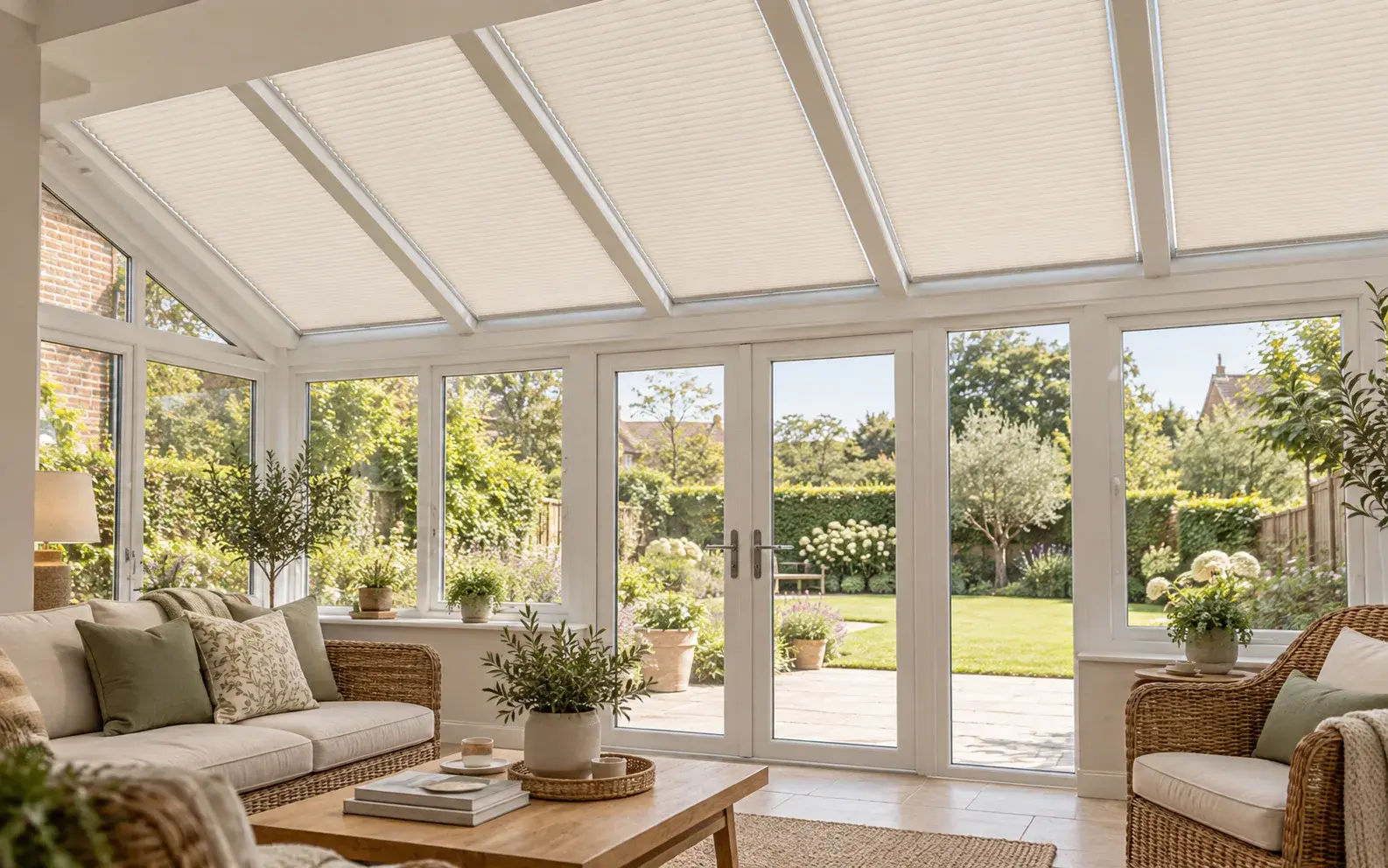
Conservatories present some of the most challenging window treatment requirements in any home. The combination of large glass areas, angled roof panels, unusual shapes and extreme temperature swings means that standard blinds designed for conventional windows simply are not up to the job. Getting the right blinds for a conservatory requires specialist products, precise measurement and professional installation.
The fundamental problem in a conservatory is heat. In summer, unshaded glass can turn a conservatory into a greenhouse — with temperatures reaching forty degrees or more on a sunny day. In winter, the same glass loses heat rapidly, making the room feel cold and draughty. The right blinds help manage both extremes. Solar-reflective fabrics reduce heat gain in summer by reflecting sunlight before it enters the room, while cellular or honeycomb fabrics provide insulation that slows heat loss in winter.
Roof blinds are usually the most important element. The roof is where the majority of heat enters a conservatory, and shading the roof makes the single biggest difference to comfort. Pleated blinds in a tensioned system are the standard solution for conservatory roofs. They run on side-guided wires or tracks, tensioned at both ends so the blind stays in position at any angle — flat, sloped or vertical. They can be opened from either end, allowing you to shade part of the roof while leaving the rest open.
Lantern roof blinds require a different approach. A lantern roof is typically a raised, pyramid-shaped structure at the centre of the conservatory roof. Standard flat pleated blinds cannot cover this shape. Instead, triangular or trapezoidal blind panels are custom-made to fit each facet of the lantern, meeting at a central point. The result is a clean, tailored fit that can be opened and closed independently on each facet.
Gable end blinds cover the triangular glass sections at the apex of a pitched conservatory roof. These are often overlooked, but an unshaded gable end lets in a significant amount of direct sunlight, particularly in the morning and evening. Shaped pleated blinds, cut to match the exact triangle of the gable, solve this neatly.
Side windows in a conservatory can take most standard blind types — roller, venetian, vertical, pleated or Roman. The choice depends on the window size, shape and the look you want. For a consistent appearance, many customers match the side window blinds to the roof blinds using the same pleated fabric. Roller blinds in a complementary fabric are another popular option.
Fabric choice matters more in a conservatory than almost any other room. Standard fabrics will fade rapidly under direct sunlight. Solar-reflective fabrics bounce sunlight away, reducing heat gain and protecting the fabric from UV degradation. Performance coatings on the reverse side of the fabric can improve solar reflectivity significantly. If heat control is a priority — and in most conservatories it should be — choose a fabric specifically rated for conservatory use.
A professional survey is essential for conservatory blinds. Every conservatory is different in shape, size, pitch angle and glazing type. Roof panel dimensions must be measured precisely because tensioned blind systems have very tight tolerances. Side window measurements need to account for any curvature or irregularity in the frame. The survey also determines the best operating system — manual cords, wand operation, or motorised with remote or smart home control.
We supply and install conservatory blinds across Milton Keynes, Bedford, Luton and the surrounding areas. The free home survey assesses your conservatory, discusses your priorities — whether that is heat control, glare reduction, privacy or aesthetics — and recommends the right combination of products and fabrics for your space.
Need help choosing the right window treatment?
Book a Free Home Visit