

Blinds, Shutters and Curtains for Patio, French and Bifold Doors
The clocks went back on Sunday 25 October, and for the next few months it will be dark well before most of us close up for the evening. Glazed doors are often the largest area of glass in a home, so this is the time of year when a bare patio, French or bifold door is most noticeable: a wide, dark pane at night, and a view straight into a lit room from the garden.
Doors are also harder to dress than windows: the covering has to work with how the door opens and still be easy to use several times a day. For homes across Northamptonshire — in Northampton, Kettering, Wellingborough, Corby and Rushden — and in Milton Keynes, Bedford and Luton, this guide sets out the main options for each type of door and what to check first.
Start with how the door opens
Before looking at fabrics or finishes, answer three questions:
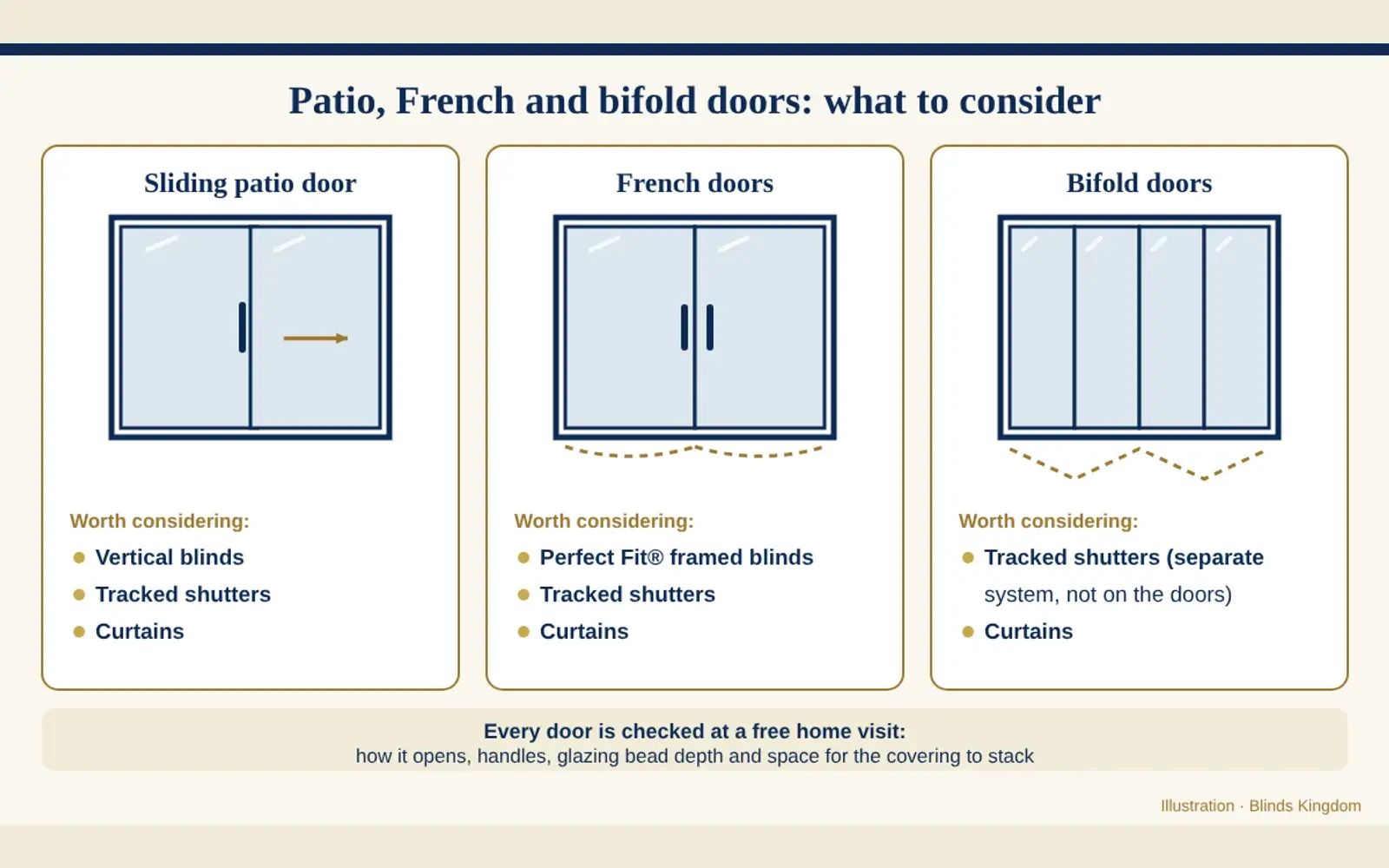
- Does the glass move? A sliding patio door has panels that glide past one another; French doors swing open on hinges; bifold doors fold back in sections. A covering fixed to the wall above behaves very differently from one fixed to a moving panel.
- Where will the covering sit when it is open? Blinds, shutters and curtains all need somewhere to go when you want the full view and the full width of the doorway.
- What is around the glass? Handles, vents, sensors and the depth of the glazing bead decide whether a framed blind can be fitted to the door itself.
Your surveyor checks all of these at a home visit, but knowing them in advance makes the choice clearer.
Sliding patio doors
Vertical blinds
Vertical blinds are the most familiar choice for patio doors, and our product page describes them as particularly well suited to them. The louvres draw smoothly across the full width of the door, and they can be split from the centre, allowing access to one side while the other remains closed.
When the blind is drawn, you rotate the louvres to adjust daylight, glare and privacy through the day: fully open for maximum light and view, fully closed for greater privacy. The stacking can be arranged to suit the door — louvres can stack to the left, to the right, divide to both sides, or, on selected systems, stack centrally. Fabrics include plain, textured, patterned, dim-out and blackout options, plus selected wipe-clean fabrics.
On operation, a wand controls both the tilt and draw of the louvres. With no hanging operating cords or chains, this is a useful Safe by Design option where suitable. Cord-and-chain and, on selected systems, motorised options are also available.
Tracked shutters
If you would like shutters on a wide opening, standard hinged shutters become impractical past a certain width. Tracked shutters bring shutter control to wide windows, patio doors and large glazed openings, confirmed at survey. They come in two main forms:
- Bi-fold: panels are hinged together in groups, and the folded stack moves along the track to one side or, depending on configuration, both sides.
- Bypass: panels move on parallel track paths and slide past one another rather than folding.
Systems may use a top track, a bottom track or both, so ask to see what the floor and ceiling will look like with your chosen configuration.
French doors
Perfect Fit® framed blinds
French doors swing open, so a blind fixed to the wall above can get in the way. A Perfect Fit® blind takes a different approach: instead of fixing the blind to the surrounding wall or recess, the frame is secured at the glazing using the approved bracket system for the selected product. Our Perfect Fit® page notes that these blinds can work particularly well on suitable French doors and conservatory doors.
Styles include selected roller, day and night, pleated, aluminium Venetian, wooden Venetian and Shutters Lite products. With Perfect Fit® Day & Night, for example, the blind moves with the opening panel and keeps the surrounding wall and recess clear; on the Perfect Fit® Day & Night systems covered by that page, controls are manual only.
Suitability depends on the glazing bead, the available depth, and the handles, vents, sensors and other obstructions around the glass. We measure the bead-to-glass depth and will recommend another fitting method or product rather than force a Perfect Fit® system onto an unsuitable door.
Tracked shutters are also listed as well suited to French doors.
Bifold doors
Bifold doors are the most demanding opening to dress, because the whole glazed width folds away and the panels move as they do. Our Perfect Fit® page is clear that sliding doors and other moving-panel arrangements need separate assessment, so a framed blind on each bifold leaf is not something to assume.
Tracked shutters can also be considered for selected bifold-door installations. They are a separate internal shutter system fitted in front of or around the door opening; they do not attach to the bifold doors themselves. Be aware that not every bi-fold shutter configuration stacks completely clear of the opening, which matters if you want the full width when the doors are open.
Curtains for any glazed door
Made-to-measure curtains suit all three door types. The main things to plan are the hardware and where the curtains sit when open:
- The heading decides how the curtains hang and how they stack when open. A wave heading stacks in a narrow column when open and needs a compatible wave track; eyelet curtains need a pole.
- Curtain weight and span affect the choice of pole or track, and the fitting depends on wall construction and fixing positions. See curtain poles and tracks.
- Motorised curtain tracks are available on selected systems and can be useful for larger windows, frequent operation, accessibility or convenience.
Standard lining adds privacy and a degree of light reduction; blackout or blockout lining further reduces the light coming through the fabric.
Evening privacy, light and blackout
Northamptonshire Police's dark-nights advice includes keeping curtains closed at night and keeping keys and valuables out of sight of downstairs doors and windows. A closed covering over a glazed door does both jobs once the lights are on.
If you also want a darker room, keep expectations realistic. Blackout vertical fabric significantly reduces light passing through the material, but a standard vertical blind does not create total blackout, because light can enter between louvres and around the blind. Tracked shutters are primarily a light-control and privacy product rather than a total-blackout system. Blackout curtain linings are not total blackout either: light can still enter around the edges, above, below or between curtain pairs. Where a fully dark room really matters, ask about our blackout blinds, where the fabric runs within a dedicated frame around the opening.
Child safety
Glazed doors are usually in family rooms, so child safety matters as much here as anywhere. The National Child Mortality Database warns that looped blind cords are dangerous to young children and babies. It advises installing blinds without a looped cord, particularly in a child's bedroom, keeping cords on blinds and curtains short and out of reach, and not placing a cot, bed, playpen or highchair near a window.
Wand-operated vertical blinds have no hanging operating loops, and motorisation can remove the manual operating loop, although it does not automatically make every installation child safe. Any blind we fit with an operating cord or chain has the required child-safety device, and we will not leave a blind installed without it. See our child safety information.
Timing
Vertical blinds are typically 3–5 weeks, subject to the selected fabric, system and availability. Tracked shutters are typically 10–14 weeks from confirmed order and final specification. Your exact lead time is confirmed before you order.
Get advice for your doors
The right answer depends on how your doors open, the space around them and how you use the room. At a free home visit, your surveyor checks the glazing, the bead depth and the handle positions, measures the opening, and brings samples so you can compare options in your own light. Choosing for a conservatory too? See our guide to window treatments for a conservatory.
We cover the whole of Northamptonshire, plus Milton Keynes, Bedford and Luton — see the areas we cover.
Sources
- Blinds Kingdom product information, read 29 October 2026: vertical blinds, Perfect Fit® blinds, day and night blinds, tracked shutters, curtains, curtain poles and tracks, blackout blinds and the child-safety section of the homepage (all linked above).
- GOV.UK, "When do the clocks change?" — last updated 24 November 2025 — https://www.gov.uk/when-do-the-clocks-change
- Northamptonshire Police and Northamptonshire Neighbourhood Watch, "Burglars love it when the clocks go back", republished by Badby Parish Council (page undated; accessed 29 October 2026) — https://badby-pc.gov.uk/be-vigilant-burglars-love-it-when-the-clocks-go-back/
- National Child Mortality Database, "Advice regarding blinds and young children" — published 15 June 2020, last modified 30 November 2021 — https://www.ncmd.info/safety/safeguarding-notice-blindcords/
Related product
Vertical Blinds →Tall louvres that glide sideways - perfect for wide windows and patio doors.
Need help choosing the right window treatment?
Book a Free Home Visit