

Do Blinds Keep the Heat In? What the Research Says
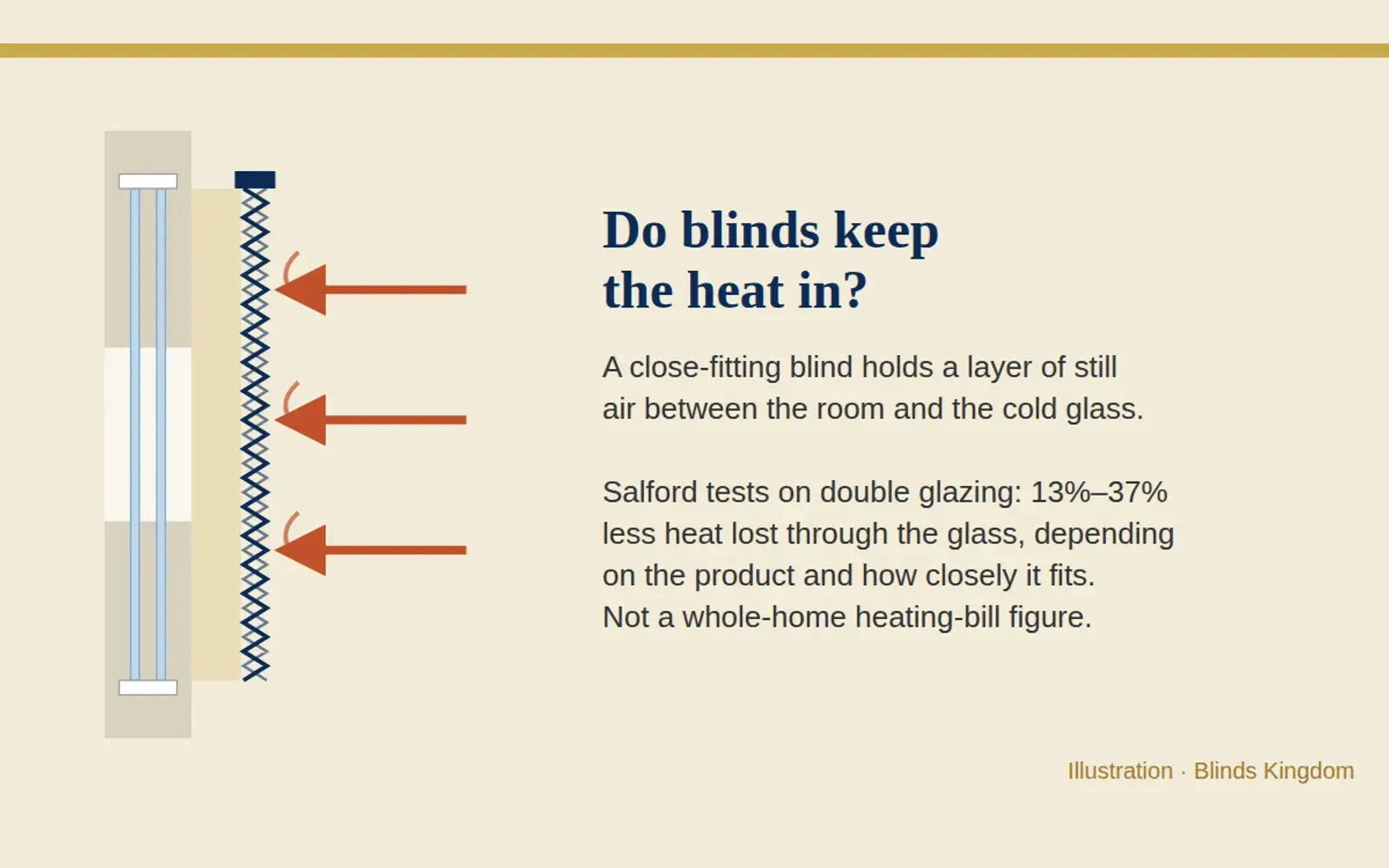
As the evenings draw in, many of the questions we hear across Northamptonshire, Milton Keynes, Bedford and Luton turn from privacy and light to warmth. Can a blind really make a room feel warmer? Is a "thermal blind" anything more than a label? And is it worth choosing one window treatment over another for the colder months?
The short answer is yes — a well-chosen, well-fitted window treatment can reduce the heat lost through your windows. But how much it helps depends far more on the type of product and the way it fits than on any marketing claim. This guide sets out what the independent research found, what actually makes the difference, and how to choose sensibly.
What the research found
The most detailed UK evidence comes from tests carried out by the University of Salford in its Energy House, a full-size replica of a pre-1920s solid-wall end-terrace house built inside a climate-controlled chamber. The work was commissioned by the British Blind and Shutter Association (BBSA) and published as an initial report in March 2023.
What was tested. The researchers measured how much heat passed through the centre of a modern double-glazed pane (low-emissivity coated, argon-filled, in a uPVC frame) with the room held at 20°C and the outside at 4.5°C. They then repeated the measurement with different blinds and a shutter in place.
What they found. Every window covering tested reduced the heat passing through the glass. Measured reductions ranged from 13% to 37%:
- Standard roller blind, hanging freely — 13%
- Roller blind running in zipped side channels (two different fabrics) — 23% and 37%
- Honeycomb blind with foil insert, hanging freely — 28%
- Honeycomb blind without insert, hanging freely — 29%
- Internal shutter — 30%
- Roller blind fitted outside the window — 21%
- Honeycomb blind with foil insert, fitted to the glass in a frame — 34%
The BBSA's own summary quotes slightly lower figures (13% to 33%) because it uses the report's adjusted values, which apply a physics model to correct every result to the same baseline glazing. On that basis the shutter result is 28% and the framed honeycomb blind 32%. The report itself says priority should be given to the measured values.
What these figures do and do not mean
- They describe heat lost through the glass, not your heating bill. The tests measured the centre of a single pane. Heat also leaves a home through walls, roofs, floors, draughts and the window frame, so any saving on a whole-home heating bill will be smaller than these percentages and will vary from home to home. The report does not estimate bill savings.
- They come from one type of glazing. All products were tested on a modern energy-efficient double-glazed unit. The researchers recommended further testing on single glazing and older double glazing; they did not report results for those.
- They are initial results. The report is labelled as an initial report, and the measurement standard used carries a margin of uncertainty.
- Fit made a visible difference. The same honeycomb blind with a foil insert reduced heat loss by 28% hanging freely and 34% when fitted to the glass in a frame. The researchers note that systems designed to reduce air movement performed better.
UK Government buying guidance on windows gives the same practical advice: well-fitting curtains and blinds can reduce heat loss through a window if they are drawn at dusk, and keeping them open on sunny days makes the best use of the sun's warmth.
Why some window treatments perform better than others
A blind or shutter keeps heat in mainly by holding a layer of still air between the room and the cold glass. Anything that lets that air circulate — gaps at the sides, a gap at the top, or a loose, single-layer fabric — weakens the effect. Three factors make the biggest difference:
1. How closely it fits the window. A blind held close to the glass, with minimal gaps at the edges, limits the air moving between the room and the window. In the Salford tests this was the difference between 28% and 34% for the same honeycomb blind. This is why the fixing position we recommend at your home visit matters as much as the product itself.
2. The structure of the material. Some fabrics are designed to trap air within their own construction. Cellular (honeycomb) pleated fabrics form enclosed pockets within the folds, adding an insulating layer at the window. Heavier linings and interlinings on curtains and Roman blinds add a further layer between the room and the glass.
3. How you use it. Even the best product only helps when it is closed. The simplest habit is to open blinds and shutters on bright winter days to let the sun in, then close them at dusk to hold the warmth.
Your options, compared
Cellular (honeycomb) pleated blinds
If keeping warmth in is your main priority, cellular pleated blinds are the most purpose-built option. The honeycomb structure traps air in pockets across the whole blind, and the slim pleated stack suits most window sizes, including conservatory side windows. They are available in light-filtering, dim-out and blockout fabrics.
Perfect Fit® blinds for uPVC windows
On suitable uPVC windows, Perfect Fit® blinds sit in a frame that clips into the window beading, so the blind is held right up against the glass with no drilling. That close, framed fit is exactly the kind of arrangement that helps reduce air movement around the blind's edges. Perfect Fit® is available in pleated (including cellular), roller, day and night and venetian styles — subject to your window's bead depth and type, which we confirm on your home visit.
Curtains with heavier linings
Made-to-measure curtains remain one of the most effective ways to add a soft, full-width layer across a window, particularly where they extend beyond the recess and drop close to the sill or floor. Choosing blockout lining or interlining adds weight and an extra layer between the room and the glass. Many homes combine curtains with a blind for both light control and an added layer in winter.
Roman blinds with blockout lining
Roman blinds with a heavyweight blockout lining reduce the light passing through the fabric and add an insulating layer — a good choice where you want the look of fabric with a neater profile than curtains.
Shutters
Shutters fitted inside the window recess form a solid layer across the glass when the louvres are closed. An internal shutter reduced heat loss through the glass by 30% in the Salford tests (28% on the BBSA's adjusted figures). Their appeal for winter is that they combine that layer with precise day-time light and privacy control, all year round.
Roller and venetian blinds
Standard roller blinds and venetian blinds do help, but a loosely fitted single-layer blind will generally trap less air than the options above. If you prefer a roller blind, ask about fitting it within the recess to keep side gaps to a minimum.
Which option suits which room?
- Bedrooms — Cellular pleated in blockout fabric; Roman blinds with blockout lining; curtains with interlining
- Living rooms — Curtains with interlining, often combined with a blind; shutters
- uPVC windows and French doors — Perfect Fit® pleated or roller blinds
- Conservatory side windows — Cellular pleated blinds (see our conservatory guide)
- Bathrooms and kitchens — Moisture-suitable options first — see our bathroom guide
A note on blackout and child safety
"Blackout" and "blockout" fabrics substantially reduce light passing through the fabric itself, but some light can still enter around the edges of any blind. Read more on our blackout blinds page.
Any blind with an operating cord or chain is fitted with the required child safety devices, and we will not install a corded blind without them. Cordless and Perfect Fit® options remove hanging cords altogether — worth considering for family rooms. See our child safety information.
Getting the fit right
Because fit has such a large influence on how well a window treatment holds warmth, it is worth having your windows measured properly before you choose. On a free home visit we look at your window type, frame and recess depth, show you samples in your own light, and explain which options suit each room, without overstating what any product can do.
Sources
- University of Salford Energy House Labs (G. Henshaw, D. Farmer, B. George), "Salford Energy House: Thermal Performance of Blinds and Shutters Testing — Initial Report v2", commissioned by the BBSA, March 2023 — https://bbsa.org.uk/wp-content/uploads/2023/03/March-2023-BBSA-Initial-Report-v2.pdf
- British Blind and Shutter Association, "Ground-breaking research by Energy House proves blinds can help save energy" (6 March 2023) — https://bbsa.org.uk/ground-breaking-research-by-energy-house-proves-blinds-can-help-save-energy/
- UK Government, "Buyer's guide: Choosing the best windows and glazing for your home" (2016) — https://assets.publishing.service.gov.uk/media/5a802d7aed915d74e33f8e80/DECC_factsheet_11.11.16_GLAZING_LOCKED.pdf
Related product
Pleated Blinds →Concertina-folded fabric that compresses to almost nothing when raised.
Need help choosing the right window treatment?
Book a Free Home Visit